Wednesday, 20 August 2014

A new direction of Teaching- BOG members and Head teachers declare


RIC-NET organized a stakeholders meeting for school management and English heads of department from the project schools and college on 20th August 2014. it was continuation of activity to Support representatives of BOGs/PTAs to develop and implement institutional policies that support ICT integration and sustainability. The meeting was held at Verina Gardens Kasese town. It was attended by head teachers, Board of governors and PTA members from the project schools and college. 6 were females and 7 males; include 3 heads of schools, members of the Board on the academic committee, heads of English department and the principal Bwera teachers college and some Tutor.
The goal of the meeting was “Raising awareness and training of Head teachers, PTA and BOG to support ICT enhanced learning/The use of monitoring tools in eight institutions” With Objectives as “To raise the awareness of the management of the schools on the use of ICT enhanced learning”. We only targeted the PTA executive committees, the Board of governors and the school management of both secondary schools and the teacher training college.

The project has 3 focus points; a) Skilling the teachers and Tutors with necessary ICT skills to improve the teaching-learning process).Work with the administrators of the schools and PTC to support the teaching process using ICT innovations and c).work with the management committee to develop policies that support the new innovations as mentioned. Thus the end result works in the dimension of teachers (to develop the mind set), learners (to improve the learning ability and concentration level) and the administration of the schools (to easy the process of monitoring and administration).The equipment that were given out are thus meant to aid this dimension in order to achieve the intended i.e. aid the process of teaching and help to develop the mindset of the teachers and the learners.
Members agreed that this is the good way with new direction and tools to be used to support learning in schools. It will move our teachers from rural setup mind of teaching to modern creative teaching. Its more learner centered innovation that will reduce laziness from the teachers and improve the learning abilities. The school management committee pledge to support the school administration in ensuring that condition are in place to support the innovations for the benefit of their learning and excelling in academics.

CENTER COORDINATING TUTORS TRAINED TO ROLL OUT PROJECT IN PRIMARY SCHOOLS IN KABAROLE AND KASESE DISTRICTS

        One of the ways of ensuring sustainability of the C4C project is by training center coordinating tutors so that they can offer continuous teacher development in secondary schools and also train and orient teachers of primary schools in the use of ICTs. In the first phase of the trainings, teachers of secondary schools were trained on the use of ICT for lesson planning and delivering lessons. In the second phase PTC tutors were trained but since center coordinating tutors are in charge of following up implementation of programs in primary schools, it was found necessary to train them so that they could offer continuous teacher development to teachers and also help roll out the C4C programme in primary schools.
The tutors discussed ways how they would help teachers in primary schools use ICTs for teaching and learning. Probable challenges were also discussed and ways how to mitigate them. The achievements so far were brought forward and some of them were; since the training of center coordinating tutors, they have also trained eighteen other teachers (4F, 14M) in the use of ICTs to teach effectively and monitor the usage of ICTs in primary teacher colleges and primary schools. These trainings were carried out at the centers and at least 2 teachers were trained from each of the center schools.
One CCT, Mr. Dumba suggested that since CfSU has been working with an experienced tutor, there should be and endeavor and emphasis to relate the stories to the curriculum and guide the teachers accordingly.

Members identified areas of emphasis where digital stories can be used as teaching vocabulary, tenses, summary, picture interpretation etc.

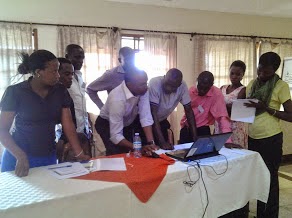
some of the CCTs in a group discussion during the workshop

Reactions from Participants
The CCTs were very enthusiastic about rolling out the program in primary schools and pledged to offer their support to see the project successfully implemented in the schools.
 Although electricity shortage was noted as one of the challenges that would affect the implementation of the program in primary schools, one of the CCTs, Mr. Sesanga, suggested that as part of their responsibility as tutors and over seers, they should ensure that schools have at least one ICT enhanced lesson in their schemes of work and will gradually improve the frequency of use of ICT for teaching English language as schools adopt  alternative means of acquiring power.

Monday, 16 June 2014

U-reporter Enables RICNET to carry out action research about her sms platform

RIC-NET has been running sms platform since 2010 to send sms alerts, receive feedback on radio programmes, sensitize parents about their roles at schools,  sensitise citizens about their roles in the governance and electoral processes, provide weather information alerts, market information and preventive health alerts.

Every year RIC-NET sends out over 500,000 sms on these different issues to over 3,500 citizens in her database residents of Rwenzori region, therefore the organisation required a clear feedback on effectiveness of these sms in delivering the intended massage.
The organisation sample two District Kasese and Kabarole and send over 1,500 sms to users the following questions:
 1. Is SMS a useful way of informing parents on issues about their children at school? Yes/No, why?
2.       Have you or your parent ever taken action because of the SMS received about education from RIC-NET?

The results of these questions are as follows

836 people responded the first question and 510 responded to the 2nd question.

Out of 836 people, 497 disagreed with sms as effective channel for information to the parents with mostly giving reasons as most parents are illiterate, expensive to buy phones, not able to engage on phones. But this contradicted the fact the 836 out of 1,500 people had responded to the poll.


Responses based on Gender on 1st question

Sex
no
other
yes
Total
F
130
4
67
201
M
234
5
164
403
N/A
132
5
95
232
Total
496
14
326
836


It was observed that mostly people from Kasese responds to sms than Kabarole District.

Responses based on sex, category per district

Category
Sex
Kabarole
Kasese
Total

no
F
49
81
130

M
51
183
234

N/A
36
96
132

other
F
2
2
54

M
1
4
5

N/A
1
4
5

yes
F
27
40
67

M
49
115
164

N/A
21
74
95

Grand Total
237
599
836


Response on the 2nd question
 55%  (282 people out of  the 510) who responded to question 2 had taken action because of the our sms. This was positive compared to 33% who regarded sms as effective in sharing education information to parents.
This  can generally imply that, though only 326 people regard sms positive, at least  282 of these take action action.

Monday, 9 June 2014

RWECO HOLDS THE TECHIE LEARNING WORKSHOP

RWECO held a the Techie II learning session for staff of organisation participating in the C4C funded projects in Uganda. Participants where drawn from  Health Child, LACCODEF, UNHCO, RWECO, I-NETWORK, CFSU     , HAG, CEW-IT and RIC-NET.
This session was facilitated by Micheal Niyitegeka a communication specialist with financial support from IICD.
participants of Techie 11 workshop


Micheal clearly started by defining a communication strategy to include  complex processes that organisation apply to ensure a the client receive a specific message and take a specific action.
He  exposed members to several examples of different communication strategies employed by both business companies and NGOs e.g. Coca Cola and TED.
He helped  participants to clearly identify and ensure they take care of key aspects of the communication as:
  • What is the message? The intended target and  impact?
  • Who is the carrier of the message?
  • The timing and  real timeliness?
  •  Localisation of the message or  products for accessibility.
  • Monitoring and evaluation of the communication process during the execution and after.
  • Sustainability of the communication strategy and the messaging.
Later, participants where exposed on how RWECO/RIC-NET has used different communication channels of carrier as part of the communication strategy. Participants looked at the different blogs combined with you-tube channels , Google searches and feedback mechanisms. The organisation online reporting tool for staff and ushahid for crowd sourcing were also exposed.
At the end of the two days workshop, all members to design communication strategy for their organization and send it to Michael for guidance and copy to Pamela.

Thursday, 5 June 2014

Teacher suprises RWECO IICD and CFSU staff monitoring the ICT enabled teaching project with their skills


on 2nd June 2014,a team from RIC-NET, RWECO and CFSU together with IICD staff toured the C4C project staff to ascertain the progress of the project and its implementation. The tour covered St.Thereza Girls SS and Kilembe. St Charles and Bwera PTC were not visited because of limited time on the side of the IICD staff. 
Objectives of the Visit.
1.      To ascertain whether the project goals and objectives are achievable or not.
2.      To acquaint the new IIC country director with the extend of the implementation of the project.
3.      Identify new intervention that can be incorporated into the project in the near future and the future for sustainability.
attending to a lesson in kilembe SS
OUTCOMES FROM THE VISIT.
 6 teachers from ST.Thereza Girls SS and 5 from Kilembe SS have benefited from the training both internal and external and are able to use the ICT tools.
a). Lesson preparation. Teachers of English showed a lot of skills in lesson preparation and presentation. The use of the equipments in lesson planning and presentation were exhibited properly. Teachers showed knowledge of the ICT tools.
b). lesson presentation: Teachers are able to present lesson using ICT tools. Lessons were prepared properly and presented in the set English rooms. Use of tools in lesson presented was well depicted. Equipments are well used in lesson presentation especially the speakers, projector and the laptop.
attending to a lesson at St. Thereza Girls Sec
C). English rooms. Schools have set aside English labs where the equipments are kept and being used. However English labs need power regulators to avoid power short circuits leading to destruction of the computers. School administration will continue working to improve the conditions in the English or language rooms.
d). Project and the school administrations. School administrations are well behind the projects and its intended objectives and goals. Head teachers are fully aware of what is taking place and are fully supporting the teachers in the implementation of the project. More schools need to be incorporated into the projects such that the results are wide in the district and bigger change can be realized. If possible more Equipment is provided relative to the numbers of teachers in schools and thus lesson preparations hampered. Servicing of the equipments in the school be done
meeting Deputy Head Techer st. Theresa Girls Mr. Nzandu
e).SMS platform. SMS have increased the parents response to the school programs especially fees payment, collection reports and attending school days and meetings. Improved effective communication in the school.
This has picked up well and results already at hand in most of the school. However there are still instances where there is delay in message to be transmitted due to network problems. Schools will still continue to provide telephone contacts for parents and other categories.
f). Use of ICT in the school. Helped in the packaging of the reports. Teachers can now access their emails and other school networks. Schools are not having ICT teachers and use any one with ICT knowledge and thus teachers of English find it hard to deal with simple mentainance problems apart from Kilembe that have a qualified ICT teacher. Administration packages in supervision, teaching, accounting and School management software’s. More other tools as camera in capturing images and voice recorders.
g).Use of the equipments given to schools. Helped to integrate the teachers in ICT, not only those from the English department but other teachers from other departments like French Kiswahili who have frequently used the tools and humanities who have frequently used the tools and the equipments. Improved the learning especially in those activities and subjects where ICT is used. “Our performance in languages has improved” according to the head teacher St.Thereza Girls. Improved composition writing among the students. Have attracted more teachers in the schools to have adopted ICT skills in lesson preparation. Thus improved computers literacy among the teachers and the students. Helped in lesson sharing among the teachers. Improved team work in lesson preparation and more especially involving the students.