Friday, 23 May 2014

TEACHERS RECEIVE INTERNET MODEMS AND DIGITAL CAMERAS DURING REFRESHER TRAININGS


   Teachers and tutors of English in Kasese districts have been implementing a project on teaching English language using ICTs. They have been trained in using various ICT tools to develop and prepare lessons and deliver them in the classrooms.  Computers for Schools Uganda carried out refresher training for teachers to renew their skills and bring on board newly recruited teachers. Apart from the training, heads of departments of English also received internet modems and digital cameras on behalf of the departments. The training was carried out on  23rd May 2014 where 20 teachers and tutors attended. This training mainly focused on boosting teachers’ research skills using the internet and using social networks as a platform to exchange information and views with other teachers/tutors across different schools. They were trained on how to use e-mailing as a means of communication and those that did not have e-mail addresses were helped to create them. Skype accounts for each of the teachers and tutors were opened to create a platform for communication amongst the teachers.
  The teachers were guided on how to use different browsers like google, bing and yahoo to search for relevant information on the web. This helped teachers expand their knowledge base as information that was got from the web supplemented the already existing information from the text books.

Apart from learning how to source for information from the web, teachers were also taken through the process of storing teaching materials on external devices for future reference and back up. This was to help resolve the problem of flexibility and viruses. By storing their work on an external disk, it would enable teachers to edit their work even within the comfort of their homes.

Wednesday, 14 May 2014

CHILDREN COME TO THE RESCUE OF KATIRI PRIMARY SCHOOL

Having heard the many reports on mass media about the floods in Kasese together with my colleagues at office we decided to spend our greater morning of Wednesday 14th May, 2014  in Kilembe.  What is reported on television is just a clip of what took place in Kasese on Thursday 8th May 2014    The place that used to be  home for many is filled with big stones and rocks. The Kilembe mines offices which used to be striking and confortable, is  host of a river  that washed away some structures. One could not resist the depressed faces of the residents who are living on hope that humanitarian aid and the government would come to rescue them from the situation.  

RWECO staff monitoring in Kilembe 14th May, 2014
 The most touching experience was at Katiri Primary school where the flood found the   head teacher and primary seven pupils in class. The situation was so alarming that the head teacher  and the pupils had to evacuate through the window. Under normal circumstances the windows were high for a human being to pass through but the little children managed to escape death amidst all the circumstances though they are now nursing browses. The  courage of the children to reinstate their school was a great motivation for  me as by  12th may 2014 morning the children were busy removing water and silt from the classes even without a formal call by the headmistress.  The headmistress of Katiri primary school was encouraged by efforts of the pupils but however complained that the thieves broke the school cupboard to steal books and other relevant information of the school. 

Pupils of Katiri Primary School, wondering what next after the school was flooded. These pupils came to clean up on Monday with their Headteacher.

 Bulembia  Primary school  was the most affected school of all as the river burst its banks and  washed away a 2 classroom block with all its furniture.  Other classroom blocks were  weakened by the water and the  big question remain  whether or not the school will be able to open on Monday 19th May, 2014  as other schools open.
It was shocking to also observe that part of the Kilembe mines offices were also washed away by the floods while the remaining part is hanging in the middle of the flowing river that burst its banks.  In my view the offices are not safe for human settled because they were  weakened by the floods.  Also the road that was reconstructed a few months ago is the new course of river Nyamwamba, however on critical observation, tarmac on the drive way  was just a small layer in a lay man’s language!!! . UNRA should do a value for money audit even when the road was washed away by the floods. 

Bulembia Primary school was totally washed away. Where will the children Go!!! Hope the Presidents visit to the affected families and institutions on Wednesday 14th May, 2014 will bring hope to the citizens.
  In my view the floods in Kilembe caused total destructruction  which will not require renovation and relief aid but reconstruction to enable people continue living without having to worry about the next the rain. I have been humbled by the efforts of the local leaders of Kasese, Hima Cement and Hima Tibeti  and CSO for their endavour to desilt the river as well as counsel the local population around Kilembe.  Man should also be blamed for degrading the environment because of Human activities around the river banks, climate change have caused havoc to human life.  The condition at Kilembe is a typical example of how climate change can affect human being and as citizen of Uganda we therefore need to protect our environment for a better tomorrow.
By RWECO Team
Sheila K, Gilbert m & Medrace

Tuesday, 29 April 2014

PUPILS PROVE TO BE A SOURCE OF MATERIALS!!

As I go round schools both primary and secondary schools the need that comes loud and clear from the teacher’s lips is lack of text books and to a greater extent, they are right for text books are the main source of teaching materials.
Are you aware that pupil’s can be a source of materials? Not easy to believe but its true!
I happened to visit Canon Apollo Demo School and was lucky to find a P.6 teacher conducting a library, lesson. Wow! That was wonderful for I had never attended such a lesson in my entire life.
I looked around the library; there were not many books that really struck my eyes. Many looked like donations that had no relation to the Ugandan curriculum.
As you very well know, most primary school pupils cover their books with news papers. These are the very materials that the teacher used for his lesson!
He asked pupils to unwrap their English language exercise books. The few exceptions who had not wrapped their exercise books with newspapers were allowed to unwrap a non – language Exercisebook.
Instruction one was “class look at your papers what can you see?”Hands went up! Pictures had caught almost every one’s eye. So, they went on mentioning what they could see. Some saw people, others bicycles, cars, houses, trees and so on and so forth.
Seeing their attention was mainly on pictures, he changed their attention to words .So instruction two was “Look at the words and only pick out words whose meaning you do not know?” They responded by picking the words pronouncing them the way they could and writing them in their exercise books. One pupil made the class burst with laughter when he read the word curriculum as “KULIKULAMU”
The teacher explained the meaning of these difficult words and asked pupils to construct sentences using the same words. He gave them freedom to either construct sentences using the newly learnt words or to describe one of the pictures of their choice.
To my astonishment, three quarters of the class took to describing the pictures. Some even drew and traced them in their exercise books which he collected at the end of the lesson. 

I noted the pupil who had picked the curriculum word had written a composition about the Ugandan curriculum sighting out its pros and cons!
My assessment of the lesson was that pupils had one: - enjoyed themselves and had been given chance to discover and be creative.
Two: - that “free-lance lessons” made the teacher cover wider rangeof topics within a very short time.
This reminds me of the 2012 joint teacher- pupil instructional material development exhibition that amazed many parents and stake holders of the district.
Story writing,calendars, clocks, art pieces and so on and so forth were some of the materials made by both pupils and their teachers.

This was a non-text book exhibition with a clear message that pupils with diligent and passionate teachers produced better work. We can say that non text book material can be made and used if the teachers are creative and passionate about what they are teaching and secondly, pupils can do a lot under the supervision of their teachers. A competent teacher can use anything to conduct a well balanced lesson rich enough to make pupils improve on their literacy and numeracy levels.

EPP STATUS QUA 2014


According to the implementers, assessmentof 2014 should be the best of the EPP’s period reason being that the systems are already in place such that every school and teacher knows what to do when to do it and how and why to do it.
The other reason why 2014 should be the best of EPP’s period is that the super 2013 P.L.E performance has given a challenge to teachers in that they have to work double hard to keep up with the performance or do even better. In other words the project has to some extent achieved one of its major objectives which is to help schools improve on literacy and numeracy levels.
On ground, interclass debate competitions are going on smoothly.The 2013 theme of Malaria prevention and observance of children’s rights continue through 2014. All the debate motions poetry, composition topics, songs and drawings depict the major national theme of Malaria prevention and observation of children’s rights.
 First term according to the school calendar is a time of developing leadership and sports skills. The EPP implementing officers have been attending the occasions to moral boost their schools and have also used the occasion to help teachers gather the ideas to use as instructional materials when they go back to class.
                         
First term also saw government implementing the school family initiative a program aimed at improving teacher pupil relationship for purposes of systematized follow up .The design of this program sees to it that every teacher  is allotted 25- 30 pupils (from p.3 -7) to parent . EPP has found this government initiative program quite good in that every parent teacher can easily identify pupil’s language problems which problems can be discussed with the class teachers during the dialogue exercise.
This year has also seen teachers becoming authors. One Gavin Stella a teacher from Busiita P/S has written a play whose theme addresses climate change and environment conservation. The parents and the community at large have watched it being acted and have hailed her for the good work done. In her own words she says “If EPP had not come to our school, I would never have known that in me was a talent”
 Schools that were given Computers have had trainings organized by the heads of schools. Currently all the teachers are computer literate and have opened internet addresses.
Mugusu primary school for example owes its increased enrollment due to the fact that some of the lessons are ICT based a thing that parents have embraced and supported.

As first term closes, we are optimistic that our pupils will carry the banner of lifting English language acquisition home with them and willcome back to school safe and sound. 

EPP A GOLDEN PROJECT

“Programs have come and gone but EEP is different and has come to stay”.
This and many more of such comments keep escaping teachers, District stake holders and parent’s lips. The question is what has made it come out as aspecial program? The answer simply lies in motivating the teachers, helping them to asses themselves and returns to their calling.
The non- conventional innovative methods of teaching/ learning are not  foreign methods of teaching but those very traditional methods wisely put together to fit the teacher’s teaching comfort as well as the level of the pupil’s capacity of grasping.

Also the co-curricular activities like MDD, Debates, sports, writing and drawing have proven that a child learns best in a free environment. It is in such moments where a child discovers his talents which talents when used wisely makes him an assertive, self-reliant, smart and quick in decision making plus making him physically and mentally fit.
                            
The annual interschool co-curricular competitions among the project schools confirmed the above statements.
The aim of these competitions was to help the pupils learn to think and communicate coherently in English language. The result showed that pupils could not only think and speak in English but that they too developed the skills that go with language acquisition.This is actually the real explanation of the increased performance in the project schools in the shortest time.
Emphasis on co-curricular activities coupled with the availability of instructional materials developed by teachers and pupils plus of course text book materials and the renewal of teachers attitudes the support of the District stake holders not forgetting the donor partners have in two years brought forth results that have put a smile on the community and the District at large.
2013 results reveal a great improvement in the general performance of the schools compared to 2012 and the year before .70% of the pupils that sat P.L.E 2013 have joined secondary schools of these 38% are girls and 32% boys. Also the statistics show that many distinctions in English language were scored. Thanks to the teachers hard work! The teachers, the community and stake holders of the district are indeed happy with the program.
One very distinctive and vivid result in the schools is the use of spoken English while on the school premises. Each school has come up with a system to use to emphasize the habit of using English thus others have fully engaged parents in the exercise making sure that they speak English when home.


Friday, 25 April 2014

FOCUS GROUP WITH TEACHERS AND SHARING LESSONS LEARNED

     According to the program design, partners were to document and share lessons learnt from the implementation of the project in the secondary schools and primary teacher colleges. The purpose of sharing and documenting was to learn and discuss how the lessons learned would impact future program implementation and also help make the program better. Computers for schools Uganda and RWECO have for the past two years been discussing these lessons in a participatory manner. This is normally done at the end of year where all the project staff gather in a central location to discuss challenges, successes and lessons learnt. Listed below are some of the lessons that have been learned since project inception;
·        Administrative support is very important for the projects to be a success since they offer both the moral and technical support to the teachers. An example of Canon Apollo Core PTC where with the support of administration, the department has been able to procure more computers for English lab.
·        There is need to train school administrators (Head teachers, principals, deputies and Directors of Studies) in ICT customized for management as without their knowledge of ICT use for management, they do not understand the need for ICTs in schools. School administrators should be trained to be champions of ICT usage and integration in the schools.
·        From the action research that was carried out, CfSU and RWECO found out that using SMS alone to communicate with parents is not a very effective method of relaying messages to parents. This method should therefore be coupled with other avenues like use of radios and community public address systems.
·        It was discovered that it is very important to encourage teachers to involve students more in the teaching/learning process to boost their creativity and research skills. This is mainly done through group discussions and take home exercises.
·        New more advanced software for developing lessons should only be introduced to teachers after they have fully grasped the simpler tools.
·        Learner involvement in the learning process through research, group discussions, collaborative learning and presentation is important as it fully engages them and reduces boredom. They need to be given time to interact with ICTs through group work and research so that the learners’ creativity, research skills, problem solving skills and critical thinking are boosted.
·        Teachers need continuous practice and re-tooling to improve their lessons and point them more towards the learner.


some of the tutors being helped during a re-tooling session

·        There is need to prepare sample and demo lessons by implementing partners and champion teachers to other teachers more exposure to learner centered lessons.
·        Continuous encouragement of teachers and hands on the computer will increase the efficiency in the use of ICT tools to teach.
·        Careers’ days and open days are good platforms for implementing partners to interface with parents since they are crucial stakeholders in the success of the project. It is crucial to tailor teacher support activities to school activities so that the school time table is not interfered with for example Careers’ day.

The teachers are tasked by the implementing partners to follow up on these lessons accordingly. An example of such a scenario is; during one of the meetings, it was discussed that it is important to involve learners more in the learning process and the teachers were tasked to help the learners be more active through assignments of research and collaboration.

Monday, 7 April 2014

LEARNER INVOLVEMENT IN TEACHING/LEARNING ENCOURAGES CREATIVITY

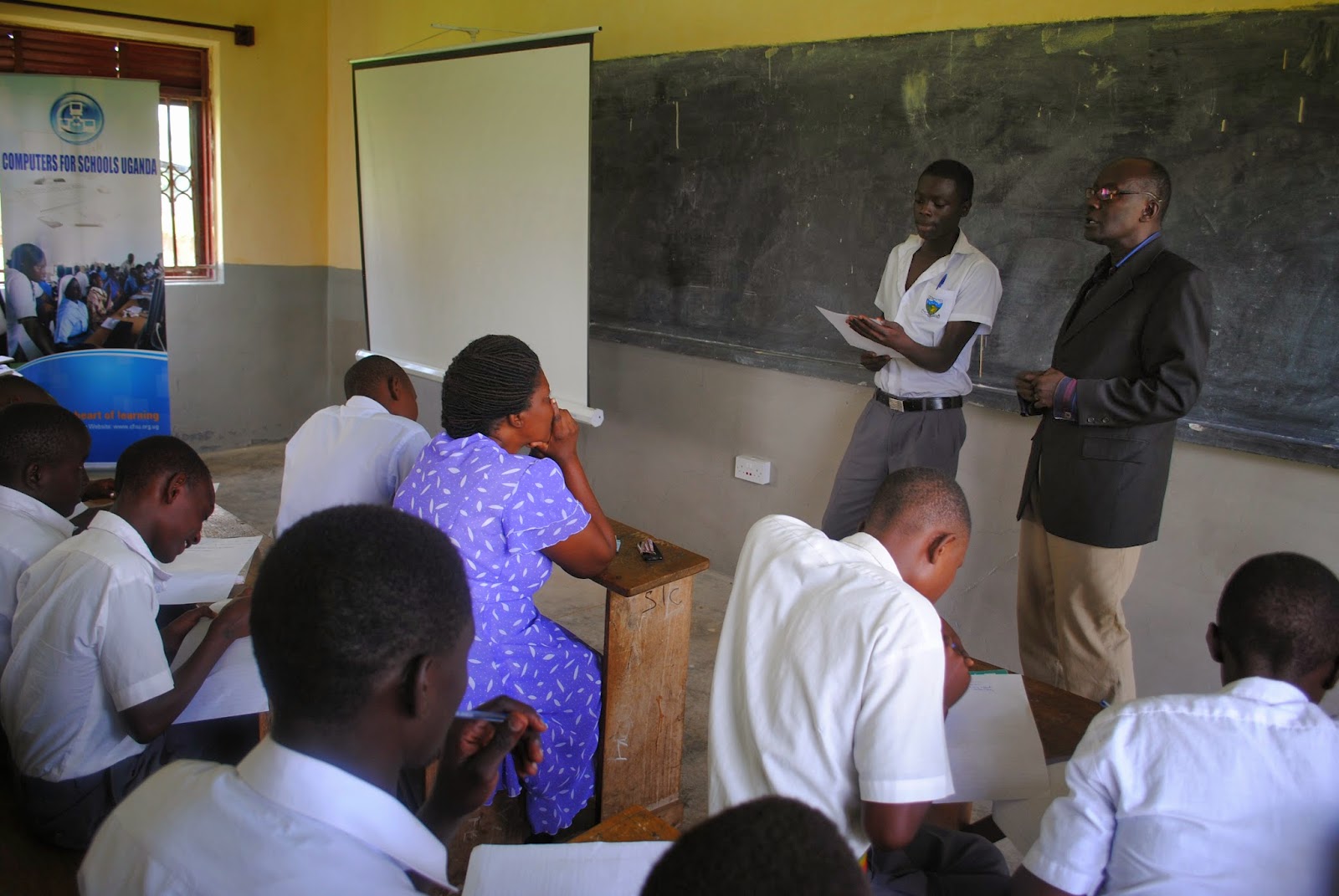
        Computers for schools Uganda (CfSU) and RWECO are implementing a project on teaching English using ICTs in six secondary schools in Kabarole and Kasese districts. The project is targeting teachers and tutors of English in secondary schools and Primary teacher colleges respectively. Teachers have been trained to use the computer and projector to teach English. Using ICTs has greatly improved subject attendance as it piques the interest of students and reduces boredom as they become more involved in the learning process especially using illustrations and simulations. Students have testified as to how lessons taught using ICTs are interesting and very enjoyable. Teachers are now involving the learners more in the teaching/learning process by giving them projects which the learners accomplish either individually or in groups.  This has given a chance to the learners to fully exploit their potential by building their research skills, innovative and collaboration skills.  Students carry out research projects and present them in plenary in the classrooms after which the teachers harmonize. This method has also boosted ICT skills levels of the students as they are sometimes tasked to look for this information on line using the computer.
A student of Ruteete s.s explaining a point as his teacher listens on

 The teachers sometimes task the students to explore different subject matters in depth and present them to the rest of the class in depth hence encouraging peer teaching. Using the computers in the English resource room, students are able to accomplish their tasks and using the laptop and projector, they can present their work to other students. This makes teaching and learning interesting for both the teacher and the student as the student is more involved and the teacher’s work load is reduced considerably.

Friday, 4 April 2014

CFSU STAFF SUPPORTS TEACHERS IN KABAROLE DISTRICT
         Computers for Schools Uganda (CfSU) carried out On-site support from Feb-April 2014. The support offered was in form of site visits to the project schools in Kabarole district. Staff from CfSU offered both pedagogical and technical support to the teachers of English in St. Leos College, Ruteete secondary school, Kyebambe girls’ school and Canon Apolo Core PTC. During the site visits, a total of 22 teachers (9 Female, 13 Male) of English were reached and 8 tutors (3 Female, 5 Male) were helped improve their skills in teaching English language using the computer. Of the 8 tutors, 3 were centre coordinating tutors and they guided on how to pass on the skills learnt to the teachers using their centres. Some teachers were also guided on how to trouble shoot simple technical problems and how to deal with them take for example how a teacher could tell software problems on the laptop, how to properly connect a projector to the computer and simple computer security (anti-virus updating and creating user accounts).
      To get the students more involved, CfSU has supported teachers to focus more on the students by giving them research projects and asking them to present them later in plenary sessions in the classrooms. This method has increased learner activeness, participation and collaboration as they are tasked to accomplish some of the projects groups.

Figure 1; A teacher of Kyebambe girls Mr. Jeff teaching poetry using the projector and laptop


Saturday, 29 March 2014

INTERCLASS CO-CURRICULLAR ACTIVITIES STRENGTHENED (28TH /MARCH/ 2014)


The star school way of doing things rotates on the idea of teaching and learning English language through any available school activity. Through music for example pupils learn vocabulary and sentence construction. Through debates pupils learn the skill of research, analysis and speech. Through writing pupils learn to express their composition form following rules of grammar while though drawing pupils learn to express themselves in picture form thus developing their creativity skills.
The themefor 2014 was” Malaria prevention and observance of children’srights.”All the interclass drama, songs, poems, dances, drawings and writing competitions rotated on this theme.
The debate motion was “If you cover me with a mosquito net you are a good parent”. The lower classes p1-4 debated in Rutooro while the upper classes p.5-6 debated in English.
To honor the occasion was the Kabarole MP Mrs. Victoria Rusoke together with the parents of the school. The day brought parents and pupils together and both learnt a lot besides having fun. Total number of pupils who participated were 1018, 507 girls and 475 boys.
The adjudicators were Mr. Wamara Edison a music legend and a teacher from canon Apollo demo the deputy head teacher canon Apollo demo Mr. Mujuni Emmanuel and Ms. Naiga victoria also a music legend from Bwanika primary school.
In Canon Apollo the upper class managed to beat the lower ones just by 32 marks while in Bwanika lower classes pulled. Primary five took the lead in every activity.
The program manager Cfsu together with the parents was pleased with the hard work and commitment exhibited by both the teachers and pupils.
The overall winners of the competition were none other than KahuliMishellep.4 from Canon Apollo and Komuhimbo Jacqueline from Bwanika who were rewarded prizes comprising of books, pens, pencils and mathematical sets.


Tuesday, 4 March 2014

Kyenjojo Citizens speak out on improving Education standards

Citizens of Kyenjojo district, during feedback session by members  attended by chairperson LC3 Nyankwanzi and Bufunjo, district counselors, sub county counselors, a team from RWECO and CEWIT, leaders of the neighborhood assembly and the sub county technical team were all moved by the issues raised by the members of  Irakalyabantu Neighborhood Assembly (NA)  on 24th February 2014.  Amidst all the interventions in the education sector, the sub county still faces the challenge of poor  P.L.E results  despite the fact that  the  sub county is blessed with 9 government aided primary schools, 3 private schools and many other subgrade schools with of course  two secondary schools of which one is a community school.
Alas for the whole sub county got 7 first grades   and to make matters worse all the grades were from private schools that is Kyamutunzi parents and Mabira Demonstration school which is the opposite in the previous year when out 9 first grades in 2012 in the sub county, 6 were from government aided primary schools and 3 were from private. Another good example is Nyamyezi primary school that has suffered the impact of staff sealing with only two teachers on government pay roll and the others are S.4 dropout managed to have the their pupils pass with Grade 2 and three while a school like Ruboona Primary School that has teachers on government pay roll out of 16 pupils who sat for P.L.E in 2013 3were in third grade and 13  un graded. The implication of this is that all the pupils of Ruboona Primary school do not even qualify for Universal Secondary Education (USE) yet they have qualified teachers.

Participants at the feedback meeting in Nyakwanzi S/C, Kyenjojo districxt, 24th February 2014
 Key factors that were identified by the leaders that contributed to poor performance in P.L.E were among others the teachers strike over low salary where the sub county chairperson explained that most teachers were demotivated due to poor salary even when the strike was called off their mind was not cleared compared to those in private schools where parents pay the teachers. It was also alarming that Nyankwanzi  sub county has only two substantive head teachers while the rest are just acting as head teachers. The acting head teachers cannot effectively do their work with authority because motivation and power. Also the parents  in Nyankwazi sub county were blamed for regarding their children as Museveni’s children  where they have left the responsibility of  educating their children to the government disguising  that UPE is free therefore children go to school without scholastic materials or even lunch thus denying them chances to concentrate especially during the afternoon classes. The leaders in Nyankwanzi Sub County were also concerned that the pupils in Nyankwanzi Sub County have no role models to inspire them to go study because those who are educated prefer not to come back to the sub county but rather stay in towns.
Ms. Sheila K of RWECO presenting at the feedback meeting in Kyenjojo on 24th February 2014
During a feedback meeting, the sub county leaders resolved that in order to improve education standards Nyankwanzi Sub County would reward the best performers in the sub county with best student’s award of UGX.50,000/  in Primary, UGX.100,000/ in UCE and UGX. 100,000/ for U.A.C.E. The sub county intends also to establish an elites association so that they can motivate young to prioritize education as well as ensure massive sensitization of parents on their role and responsibility to fulfill education requirements for their pupils. Monitoring and support supervision of schools by the leaders would also be a key strategy to ensure that teachers are doing their work as well as motivated.  The leaders also resolved to start a campaign on providing lunch to the pupils while at school.
Compiled by:
Sheila K
Gilbert M
Nyaika R

Tuesday, 5 November 2013

Promoting English Language in Schools

By; E-Society Kasese
 
 Rwenzori Information Centre Network (RIC-NET) in conjunction with RWECO all operating in the Rwenzori region has been carrying out sensitization to improve students participation in English language through various activities like training English teachers in computerized teaching.  
 
RIC-NET invited various schools to participate in Easy writing, poetry and painting under the themes “How adequate have the government interventions in boosting Agriculture and education sectors been in light of the different, NAADS, USE and UPE initiative”, Art and painting under “A child friendly environment”.
 
Poems attracted several schools in the 7 Districts of Kasese, Kyenjojo, Kabarole, Bundibugyo, Ntoroko, Kamwenge and Kyegegwa.  
 
Many schools were invited in Kasese District and some didi not participate. Those which participated are  Mutanywana S.S, St. Thereza Girls S.S, Kilembe S.S, St. Charles S.S, St. Johns P.S Maliba and Bwera Dem School. 
 
Mutanywana S.S.S  emerged the best over all performer followed by St. Thereza Girls which also had the over all best student in Essay writing. Best participants were rewarded with certificates, and a few scholastic materials.
 
At St. Charles S.S
Student at St. Charles S.S receiving certificates


pupils at St. John P.S Maliba receiving certificates 

On delivering certificates to all the participants in the above schools this week by the RIC-NET staff the students, pupils and teachers were filled with joy and happiness receiving good news of harvest.
Different teachers in different schools expressed their happiness to Ric-Net
 for having intervened in the Education sector and motivating the learners to join such competitions.